
 Publikacija: Puhar, Alenka. Peticije, pisma in tihotapski časi. Maribor, 1985.
Based on the materials from her collection, Alenka Puhar published the book Peticije, pisma in tihotapski časi (Petitions, Letters and a Time of Smuggling) in Maribor in 1985. The book was based on her experience of participation in the petition for the abolition of the death penalty in Yugoslavia, which was conducted at the end of 1983. A group of citizens, including Alenka Puhar, sent the petition to various institutions, including the Assembly of the Socialist Federal Republic of Yugoslavia. The petition was not successful because the death penalty was abolished only in 1989, but it paved the way for new civil society campaigns in Slovenia, which had their peak in the Slovenian spring at the end of the 1980s, and in the collapse of the communist regime followed by the establishment of the independent Republic of Slovenia.
The book was first published in 1985 and it had two reprints in 2005 and 2009.
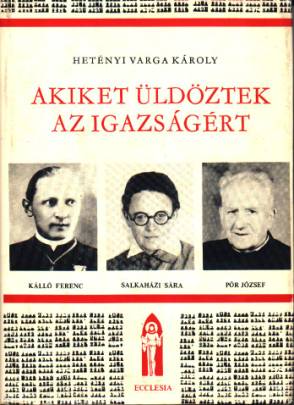
 Károly Hetényi Varga. Those who persecuted for the Truth. Clerical Fates in the Shadow of the Swastika and Arrow Cross, 1985. Manuscript
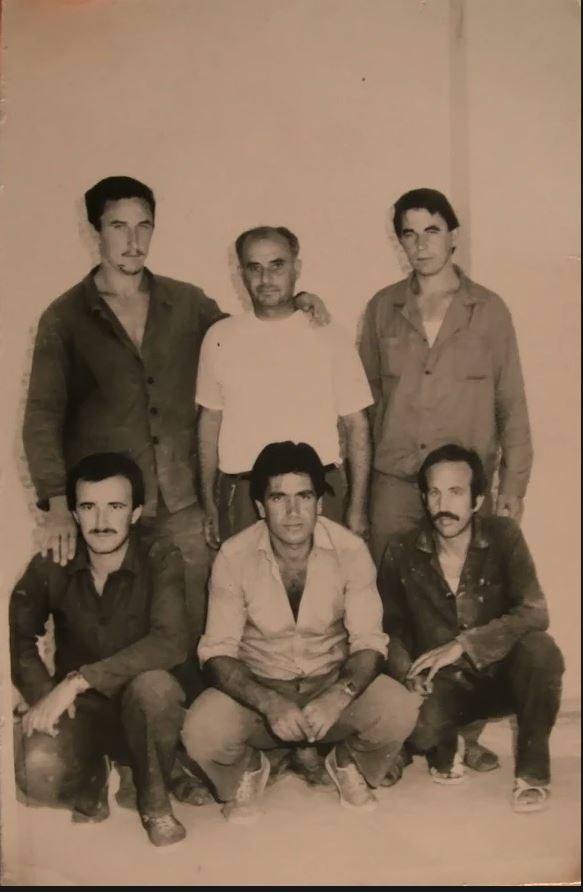 Secretly taken photo from the forced labour camp in Belene
Снимка от личния архив на Сюлейман Казимов Саадетинов (Süleyman Kazımov Saadettinov), показана и дадена за сканиране по време на интервю през март 2010 г. Сюлейман е отдясно на снимката, клекнал, с мустаци.
Сюлейман Казимов Саадетинов е роден на 9 април 1951 г. в село Башево, област Кърджали. Работил е като машинен инженер. По време на "Възродителния процес" при кампанията за принудителна промяна на имената през декември 1984 г. Сюлейман Казимов Саадетинов отказва да промени турските си имена с български. Съпротивата му е мирна – участва в малък мирен протест. Но заради тази съпротива, Сюлейман е арестуван и изпратен в затвор, а след това – в лагера за принудителен труд в Белене на остров Персин на р. Дунав. След около една година престой в лагера е освободен, като му е наложен изпитателен срок. През лятото на 1989 г., няколко месеца преди рухването на социалистическия режим, Сюлейман Казимов Саадетинов е експулсиран със семейството си от България. Семейството намира убежище в Турция, живеят в Бурса. Сюлейман има двойно гражданство - българско и турско.
Според разказа на Сюлейман, снимката е била тайно направена/заснета в момент, когато лагеруващите са изведени да работят извън лагера. Сюлейман и приятелите му виждат фотограф, правещ снимки на обикновени работници и го молят да направи снимка и на тях. Неизвестният фотограф заснема тайно от охраната групата затворници и след една седмица им занася проявената снимка. При освобождаването от лагера Сюлейман успява да изнесе снимката.
Според свидетелски показания това е единствената снимка от 1985-1986 г. на затворници от лагера за принудителен труд в Белене.


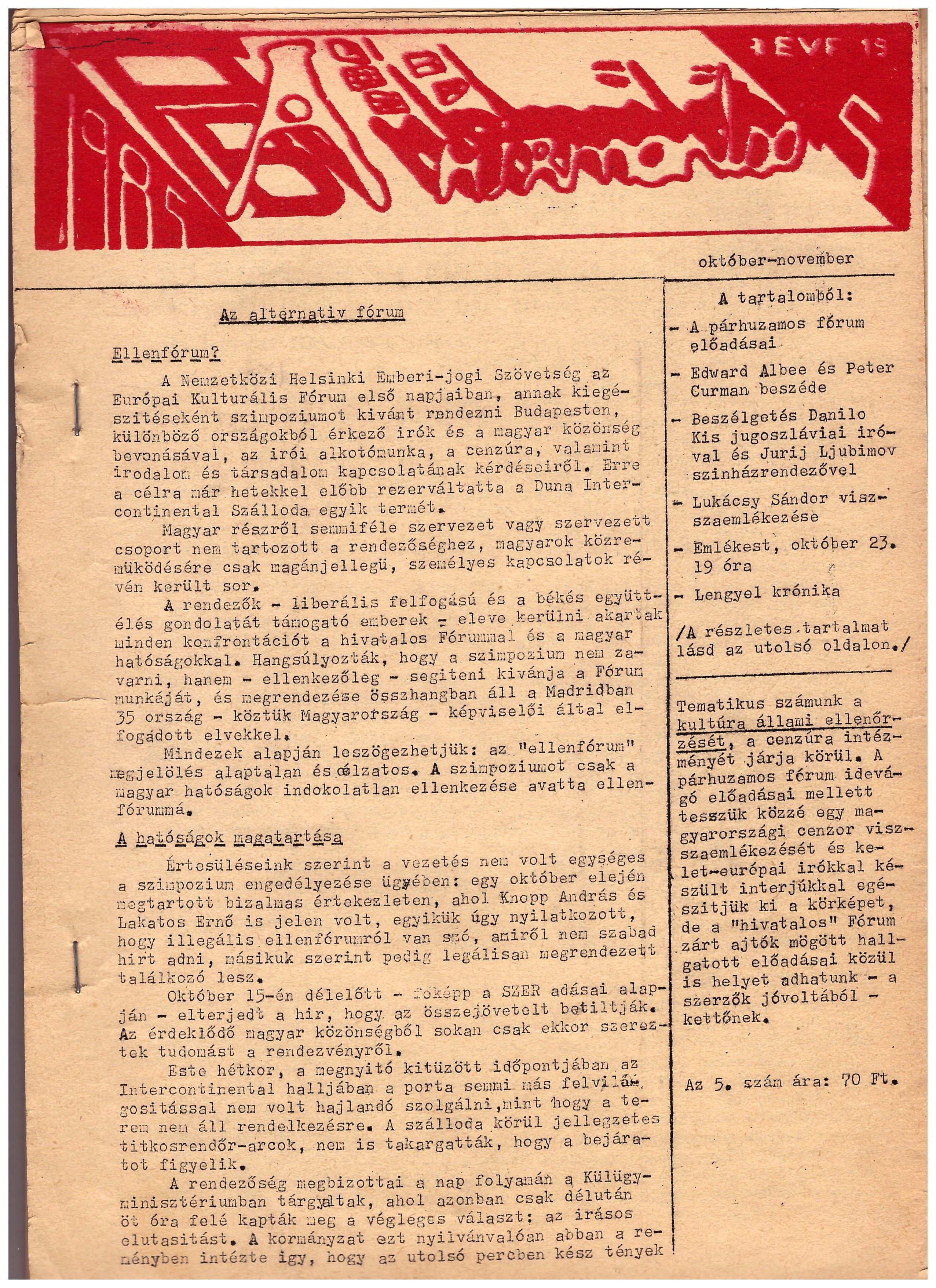
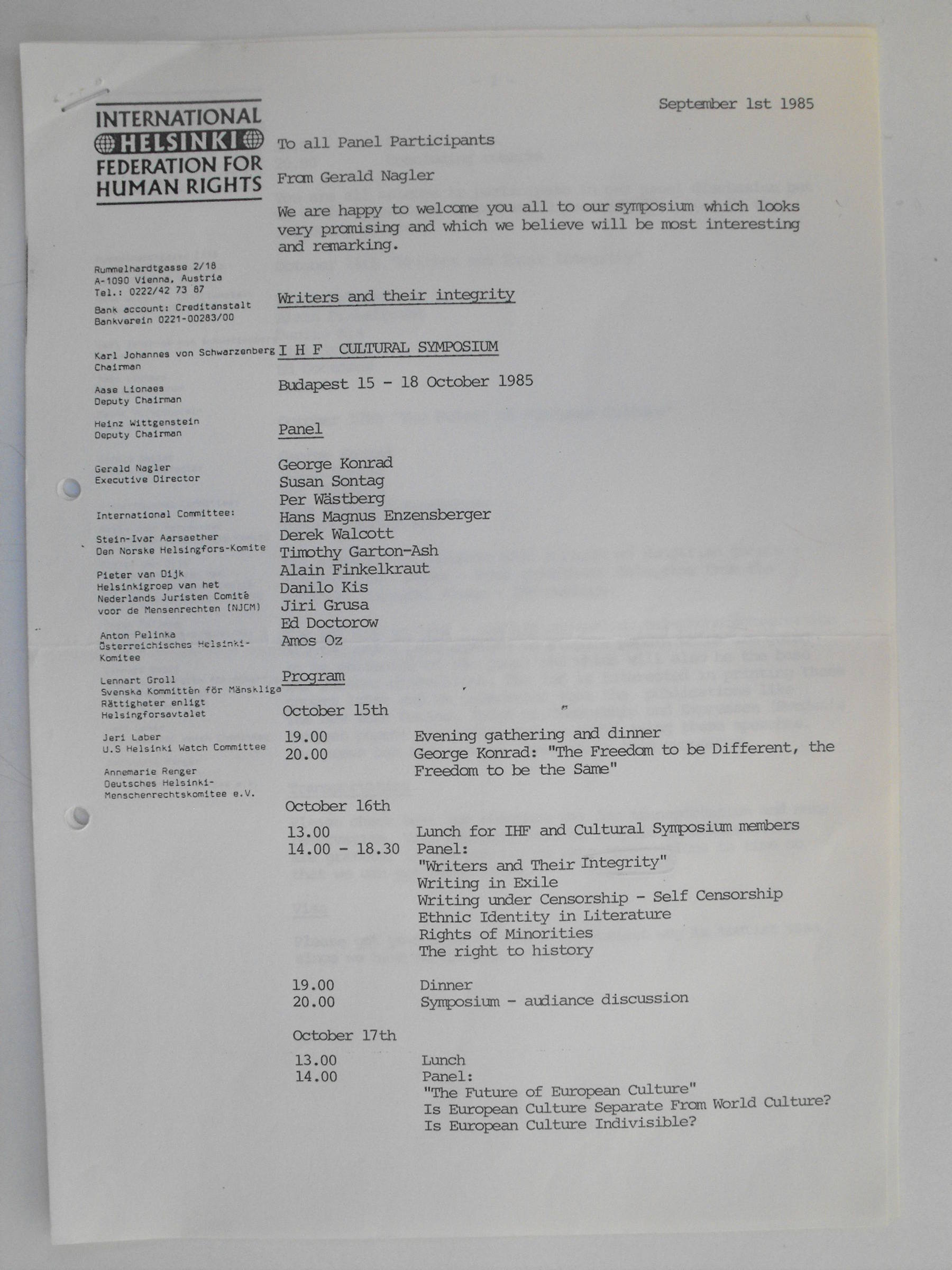 Invitation for the IHF Cultural Symposium, Budapest, 15-18 October 1985. Manuscript
Invitation and program schedule for the IHF Cultural Symposium, Budapest 15–18 October 1985
Although the plans and practical preparations for the alternative programs of the Budapest Cultural Forum 1985 had been started more than a year earlier, it was this invitation letter and program schedule sent to all Western participants by the International Helsinki Federation from its Vienna Office, an invitation signed by Chairman Karl Joachim Schwarzenberg on 1 September 1985, that proved the success of devoted efforts made by the IHF staff to organize a three-day East-West Cultural Symposium in Budapest in parallel with the official opening session of the CSCE European Conference.
The main subjects of the alternative forum were much more challenging. They included “Writers and their Integrity” and “The Future of European Culture,” and they offered a good opportunity for free and stimulating exchange of ideas for participants from both East and West. The list of authors invited seemed quite imposing, as it included prominent figures such as György Konrád, Susan Sontag, Per Wἃstberg, Hans Magnus Enzensberger, Derek Walcott, Timothy Garton Ash, Alain Finkelkraut, Danilo Kis, Jirzi Grusa, Ed Doctorow, and Amos Oz. This forum was perhaps the first chance since 1945 for writers from both East and West to enter free public debates on sensitive cultural and political issues such as exile, censorship, self-censorship, the role of national identity in literature, the rights of minorities, the right to history, or the basic question of whether European culture is separate from world culture. And is European culture really one indivisible culture? These questions and issues represented an utterly new approach which regarded cultural freedom as a vitally important and integral part of the overall realm of human rights.
How did the Budapest “Cultural Counter-Forum” manage to implement the promising plans made by the IHF? Not quite as was expected. Apart from Hungarians, no other participants from Eastern Bloc countries could attend the symposium, either because they could not get passports or because of the were forced to live under police surveillance or under house arrest, or they had been interned or jailed, like many Russian, Polish, Czech, Slovak, and Romanian writers at the time. They were partly represented by some Western writers with Eastern origins, e.g. Jirzi Grusa, Danilo Kis, and Amos Oz, and Timothy Garton Ash, who came from Warsaw to Budapest, spoke for the Polish writers who at the time were still suffering from the harsh measures of martial law. Things were similar in the case of writers who belonged to ethnic minorities. Hungarian participants, like poet Sándor Csoóri and philosopher Gáspár Miklós Tamás, spoke on their behalf, as did two of the most harassed writers and samizdat makers, Géza Szőcs, who was originally from Cluj / Kolozsvár / Klausenburg, and Miklós Duray from Bratislava / Pozsony / Pressburg. Szőcs and Duray addressed open letters to the participants in the Counter-Forum
How many people took part in the forum? As many people (120–150) as could fit in the crowded private Budapest flats provided for the event by poet István Eörsi and film director András Jeles. These people were IHF representatives, writers, journalists, Western diplomats, Hungarian intellectuals, and students. This constituted an unanticipated change which gave the Counter Forum a fairly informal and non-conformist feel. The Hungarian authorities refused to allow the group to hold its gathering in any public place, and the reservation made by the IHF for a conference room in a downtown Budapest hotel was cancelled at the last moment by the Hungarian secret police. On the very first day of the six-week-long official Forum, this scandal, which was reported on by the world press and some Western delegates, all of a sudden drew attention to the Counter-Forum, highlighting the fact that cultural affairs are still sensitive political issues in the eastern part of Europe.


 Irina Margareta Nistor - Colecție privată
The Irina Margareta Nistor Private Collection includes a series of written documents, together with a few dozen VHS video cassettes preserving a small part of the Western films that were introduced clandestinely into Romania between 1985 and 1989, to be translated and dubbed and then distributed on video cassettes (semi)clandestinely. This collection epitomises a popular culture phenomenon without any equivalent in Eastern Europe, which emerged in Romania as a reaction to the reduction of the official programme broadcast on television channels to just two hours per day and to news broadcasts about the activity of Nicolae Ceauşescu and the leadership of the Romanian Communist Party.

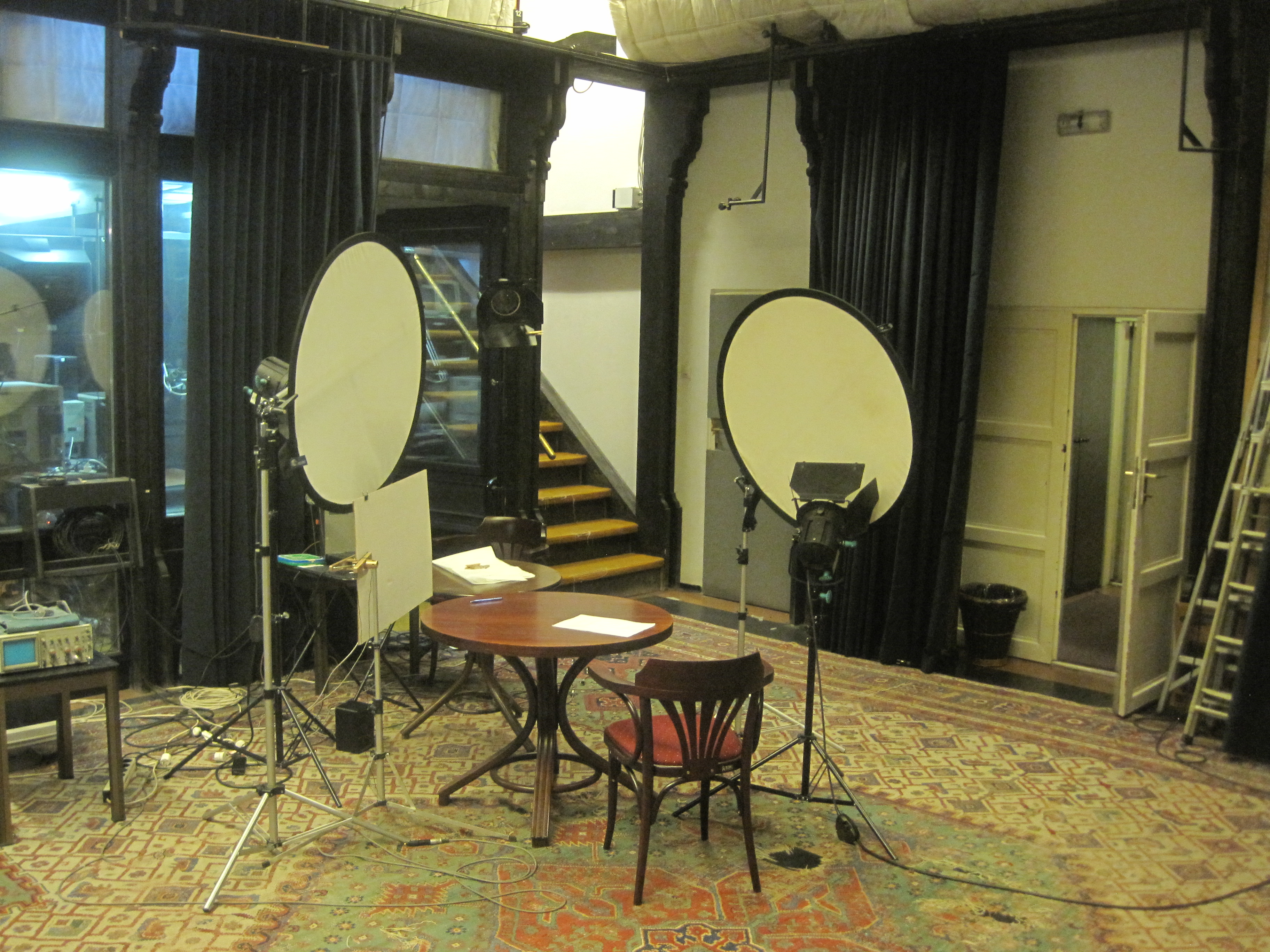
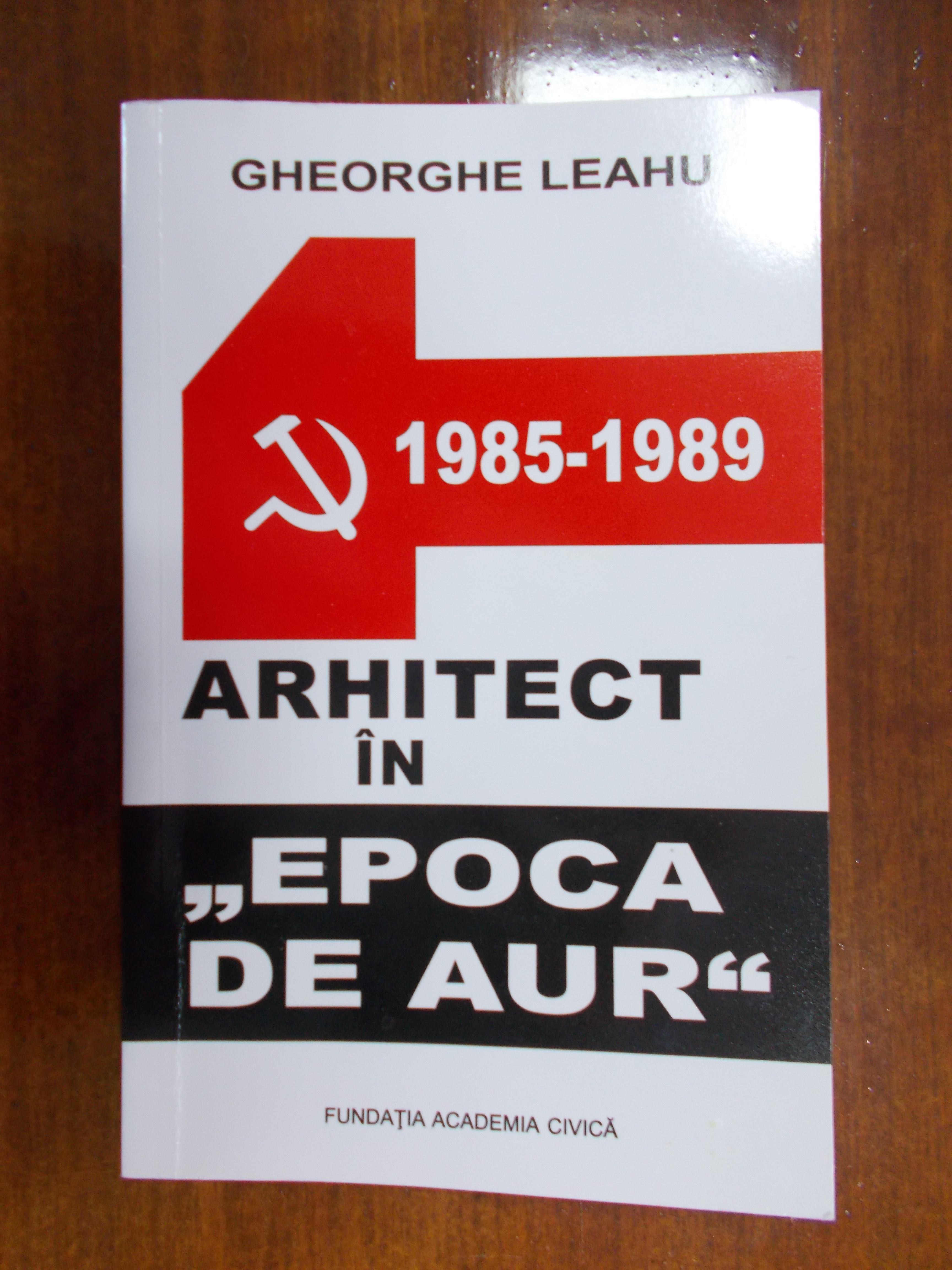

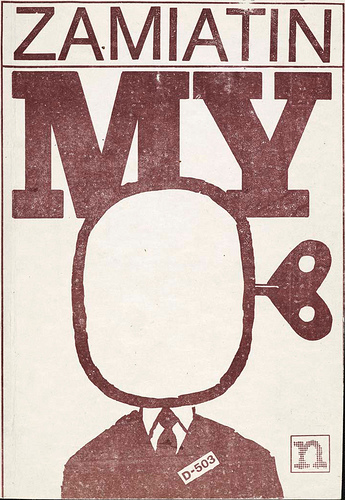
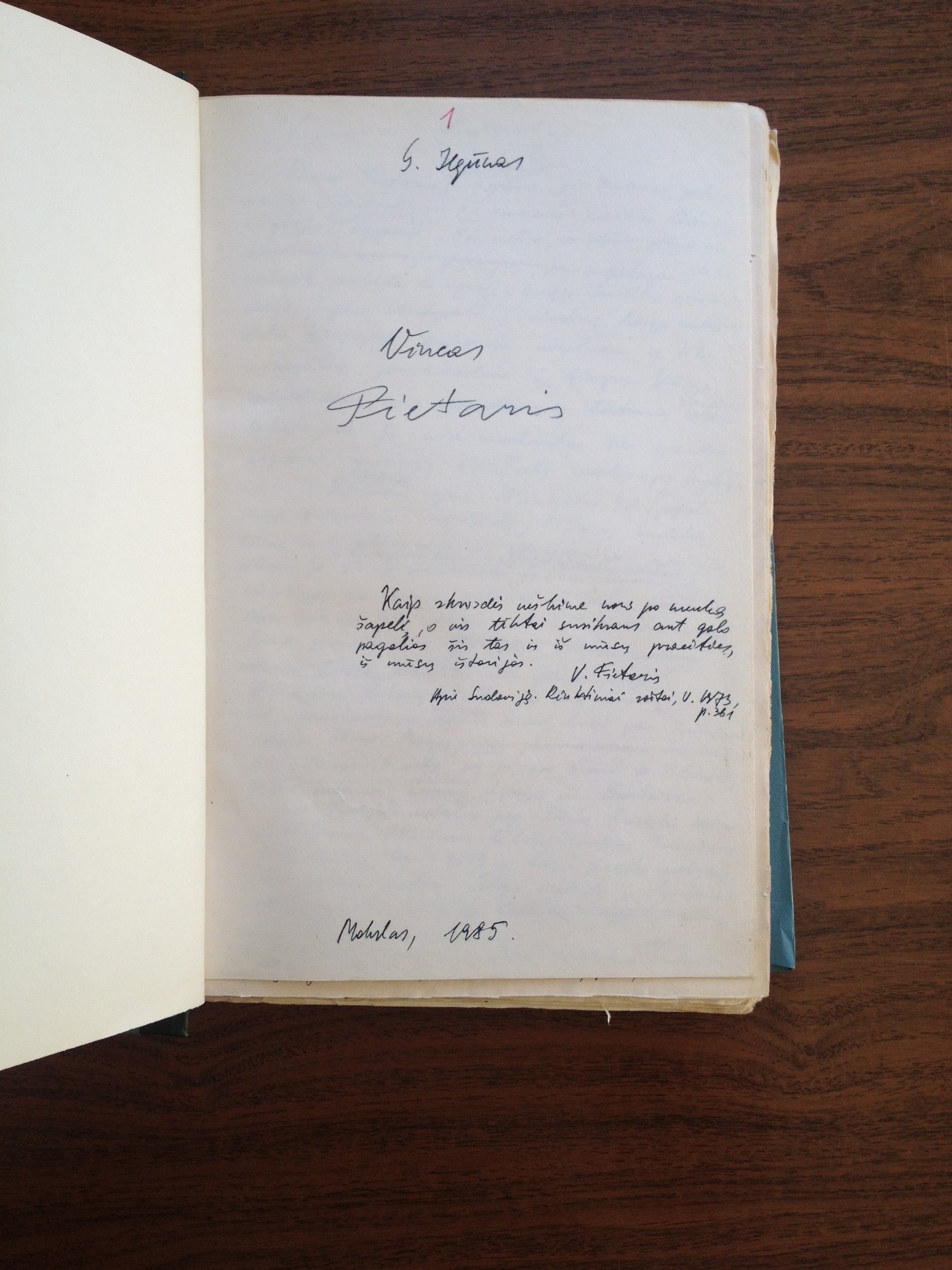
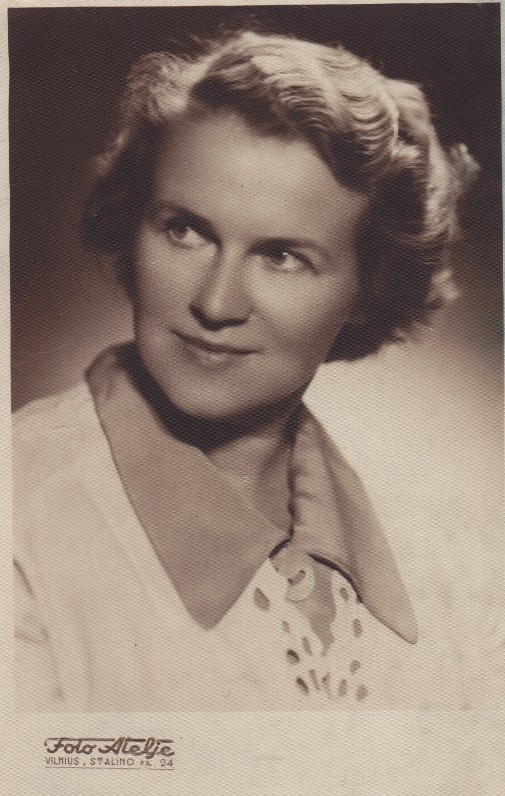 Aldona Liobytė collection
‘Aldona Liobytė. Smiling Resistance' was the title of one of the first books about the writer, publicist and interpreter Aldona Liobytė. Being a very active person with a strong sense of humour, Liobytė initiated and led informal networks among the Lithuanian intelligentsia. She kept up social ties and correspondence with many artists, discussing and making suggestions about creative work and everyday life, as well as supporting the ideas of the younger generation of artists. Through her personal ties and networks, she expressed an outlook (usually in the form of humour, irony or sarcasm) that had a sense of the existence beyond official Soviet ideology. While she was forced to leave her job at the Literary Fiction publishers because of her un-Soviet attitudes, she continued to work in the cultural sphere, writing for children and the younger generation. Translating from other languages was also an important activity and a reliable source of income for Liobytė's family . The collection consists of the papers of Aldona Liobytė, which are split between the Maironis Lithuanian Literature Museum and Liobytė’s daughter Gintarė Paškevičiūtė-Breivienė.
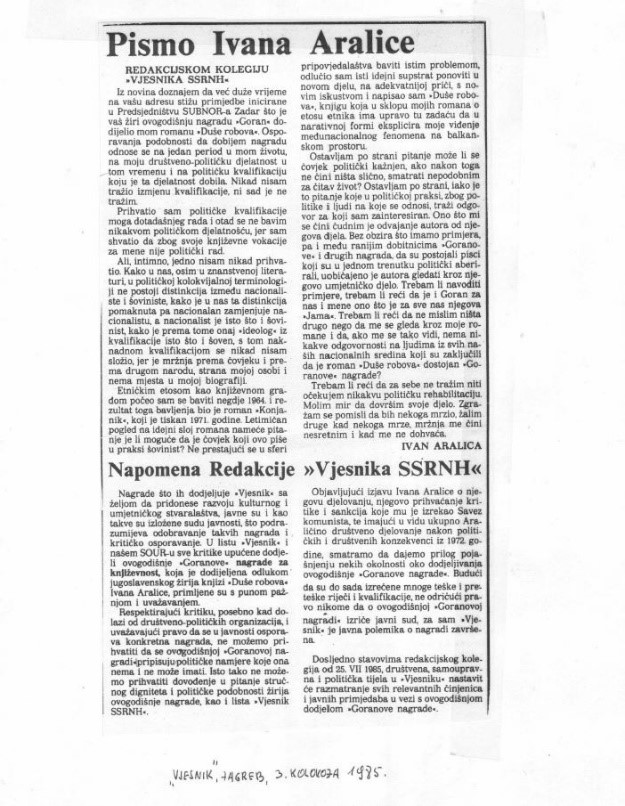
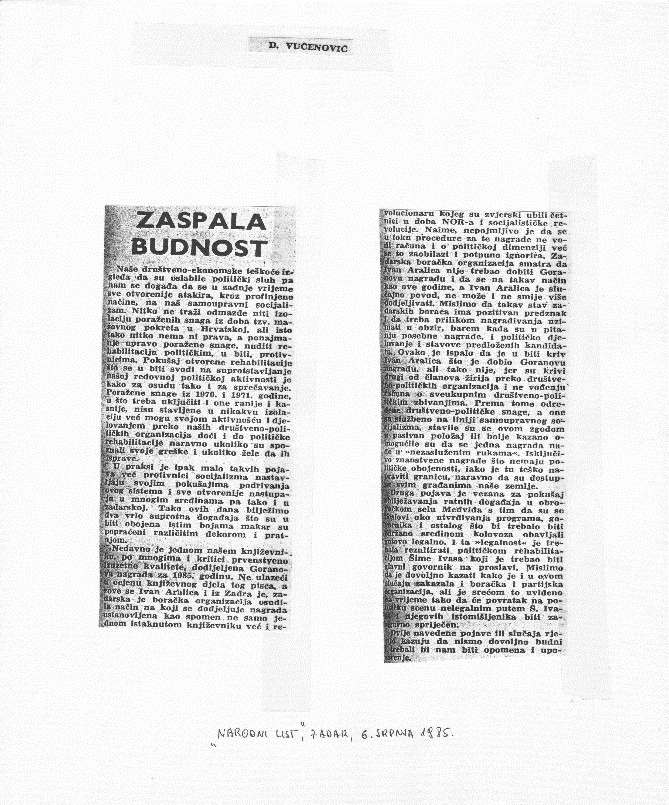 Vučenović, Dane. "Zaspala budnost." Narodni list, 6. srpnja 1985. Novinski izrezak
After Ivan Aralica had been granted the Vjesnik literary Ivan Goran Kovačić Award for literature, members of the Zadar branch of SUBNOR condemned this act. This was first commented by the local weekly Narodni list in a lead under headline “Vigilance fell asleep” written by the editor-in-chief Dane Vučenović. In the article, the frequency of attacks on self-management socialism is mentioned and the attempts of “defeated groups from the era of the so-called ‘massive movement in Croatia’.” Vučenović stressed that in that period the opponents of socialism increasingly came out openly in many centres, and so in Zadar, where the writer Ivan Aralica lives, the winner of the Ivan Goran Kovačić Award for the novel The Souls of Slaves (1984). He agreed with the SUBNOR Zadar branch, which criticized the Vjesnik jury for giving the award to a writer whose profile was inadequate because of his participation in the Croatian Spring in Zadar. “We think that such an attitude of the Zadar veterans has a positive significance, and that in the process of giving awards, the political profiles of candidates should be taken into account, at least when special awards are at stake,” Dane Vučenović concluded, indirectly pleading for interventionism in the assessment of literary works.
Ivan Aralica himself stated in his letter of 26 July 1985 to Zlatko Crnković that this lead was an overture for the attacks on him: “It has been a long time since I wanted to write to you, ever since I came to Zagreb at the beginning of July, because right on the eve of my departure from Zadar the campaign against me started with the lead in Narodni list (Aralica and Crnković 1998, 123).
 Familja Radio Warszawa concert-environment, photo, 1985
The Dziekanka Workshop was the space of intersection of many domains: visual arts, theatre, music, philosophy. Among music groups that gave concerts in Dziekanka, one might mention punk bands TZN Xenna and Dezerter, intuitive Ossian, and ephemeral projects set by Krzysztof Knittel, Marcin Krzyżanowski, Mieczysław Litwiński, Andrzej Przybielski, and other avant-garde musicians. Familja Radio Warszawa was related with Dziekanka as well. The group was established by Jerzy Caryk, Kuba Pajewski, and Libero Petrič with the participation of many other musicians, artists, and actors. The group combined musical improvisation with electronic experiments and joyful atmosphere while their performances were enriched with elements of theatre and astonishing scenographies. The photography made by Tomasz Sikorski presented the installation-environment created by Familja Radio Warszawa in Dziekanka, December 28-31, 1985.
 Felhívás a Bethlen Gábor Alapítvány támogatására, 1985. Levéltári irat
 Secret report of the Hungarian State Security Service, 16 October 1985. Manuscript
Secret report of the Hungarian State Security Service, 16 October 1985
The state security services of communist Hungary began to follow the preparations underway for the Counter-Forum Budapest 18 months earlier, i.e. as early as March 1984, by gathering regular information and agent reports on the informal meetings of IHF representatives and some Hungarian dissident intellectuals in Budapest. By the opening of the official CSCE Cultural Forum in mid-October 1985, the entire staff of the Hungarian secret police had been mobilized with the main task of preventing any potential conflict or open scandal before, after, or during the six-week-long prestigious East-West diplomatic conference, as a “top secret” daily information report dated 16 October 1985 (just one day after the grand opening of the CSCE Conference) clearly proves. It seems to be a telling sign of flurry and an excess of caution or paranoia that on that day this was the second report submitted by the secret service on the same subject: reporting on all suspicious signs and information concerning the efforts of the IHF to find public places: restaurants, conference rooms in downtown Budapest for the use of the Counter Forum. This brief report, which contained both false and misleading information, also illustrates the incompetence of the Hungarian secret police, as they do not seem to have been aware of the latest news, according to which the Counter-Forum had been refused permission to hold its session in a public place a day before and so was hosted by Hungarian dissident poet István Eörsi and film director András Jeles, who offered their private residences for the sessions.
Gyula Horn, Head of Department of Foreign Affairs in the Communist Party’s Central Committee and Hungarian Prime from 1994 to 1998, was responsible for conducting and ensuring the smooth operations of the CSCE Conference in Budapest. He must have known about the parallel preparations of the IHF’s Counter Forum, and he might also have had a decisive role in the official refusal of the IHF demand for public space, which was issued in written form by the Hungarian Ministry of Foreign Affairs. Years later, after 1990, when he was asked about this by reporters, he replied with an obscure allusion to the fact that there were far too many high-ranking Soviet and Eastern Bloc delegates who expected Hungary, the host country, to adopt firm measures in order to resist “the pressure of Western countries.”
 Sculpture "Window"
Зиятин Нуриев е роден в село Мост, община Кърджали (1955). Завършва Казанлъшката художествена гимназия, след това следва в Националната художествена академия в София, специалност живопис, като през втората година се прехвърля скулптура при проф. Илия Илиев. Художествената академия завършва в София през 1982 г. Първоначално работи в базалт, един от най-твърдите материали. Предпочитаните му теми са фигурата и портретът. Извежда човешката фигура до абстрактна форма, използвайки различни материали – мрамор, бронз, дърво, керамика. Още първите му участия в национални изложби са забелязани - през 1985 г. на Националната младежка изложба получава наградата на Съюза на българските художници (СБХ), а две години по-късно - и годишната награда за скулптура на Съюза на художниците. Негови произведения са откупени от НХГ, СГХГ и от други водещи галерии в страната.
По време на т.нар. Възродителен процес (опит на Българската комунистическа партия за насилствена асимилация на мюсюлманското население (турци, помаци, татари, роми), Зиятин Нуриев е прекръстен с името Златин Норев. Възродителният процес започва в началото на 1970те г. и продължава до края на държавния социализъм. Мерките за осъществяване на тази политика се състоят в принудителна смяна на арабско-турските имена с български, ограничения в използването на родния език от представителите на тези групи, насилствено ограничаване на техните традиционни обичаи и ритуали, и изповядването на тяхната религия. Асимилационната политика на социалистическата власт предизвиква вълна от съпротивителни действия, която изиграва значителна роля за оформянето на открито гражданско противопоставяне на комунистическия режим. До 1990 г. Зиятин Нуриев работи в България, след това се премества в Истанбул.
Запитван често дали се чувства огорчен от България заради "възродителния процес" и смяната на имената, Зиятин Нуриев отговаря: "Към държавата се чувствах огорчен, но не като население, а като управа да кажем. Как мога да се огорча и обидя от мои приятели, познати, комшии, те нямат никаква вина. Те бяха повече учудени и стреснати от нас. Защото ние все пак бяхме по някакъв начин подготвени преди това. Нещо ни се подсказваше. Докато аз помня много хора, колеги и приятели, които буквално се разплакаха. Но това са неща други – етнически принадлежности, това, онова - за мен не е проблем. Това е друга история. Ако ме попитате дали съм обиден или огорчен от България – не, категорично не. Защото България е моя родина. Радвам се, че на изложбата снощи не ме оставиха сам. [...] Аз не съм патриот – нито български, нито турски. (Джамбазов 2016)
„Промените в България през 90-те години създадоха условия, благодарение на които заминах за мегаполиса [Истанбул – A.K.] Но не бях го планирал. Не исках да си тръгвам от собствената си страна. Спомнете си лудостта от 1989-та, когато много хора бяха изгонени или принудени да напуснат родината. Не че не исках да видя широкия свят и да поживея в него, но не приемах да стане по този начин. Затова в Истанбул пристигнах не като изселник, а като обикновен турист (1990). Беше лято и с мой приятел тръгнахме из музеите. Вървяхме по булевард "Истиклял", а после влязохме в търговски център за текстил и мода. Веднага ни лъхнаха лукс и блясък, озонирани с невероятни аромати. Представих се на уредничката и показах диплянката си. Оказа се, че сме попаднали във Вакко ("Vakko") - верига магазини с галерии в най-големите турски градове - Истанбул, Анкара, Измир... Първата ми изложба в Турция беше във Вакко("Vakko") Анкара през 1991 г. Същата година ме поканиха на преподавателска работа във Факултета по изящни изкуства на Университета "Мармара". Там вече 16 години водя ателието по каменоделство, което всъщност основах. […] Помните ли възродителния процес?- Всички трябва да го помнят, за да не се повтори подобна дивотия. Но аз трябва и да го забравя - заради отношенията си с моите приятели, съграждани, сънародници “ (Джесур 2006)
Зиятин Нуриев има участия в международни симпозиуми и изложби в Полша, Турция, Япония, Канарските острови и др. Той не прекъсва връзката си с България, прави изложби в Бургас (галерия „Пролет“, 2006), Варна (Галерия 8, 2014), Пловдив (галерия „Резонанс“, 2015), Кърджали и София (2016). Негови пластики могат да се видят в редица български градове.
Склуптурата „Прозорец“ е създадена през 1985 г. – година, през която кампанията за масова смяна на арабско-турските имена с български е в разгара си, като в нея са ангажирани всички структури на администрацията, репресивния апарат и казионните организации на тоталитарния режим -само за два месеца са преименувани над 800 хиляди души. Асимилационната политика на социалистическата власт предизвиква вълна от съпротивителни действия, която изиграва значителна роля за оформянето на открито гражданско противопоставяне на комунистическия режим. Зиятин Нуриев изразява протеста си в скулптурите си. Независимо от сходството в материал и техника между „Прозорец“ и по-ранни творби (Сън, 1982; Бяла светлина, 1983; Глава, 1984), разликата в посланието на скулпурата е значително: „Раната от непоносимо насилие е изсечена в тази склуптура, рана, нанесена върху нравствеността на личността, на рода, на обществото. Прозорецът на Зиятин Нуриев ни предоставя възможността и невъзможността да се докоснем до това, което никога няма да преживеем. Възможността – защото е извадил на повърхността айсберга на болката, невъзможността – защото е заключил всички външни изразители на болка.Липсват очите.Липсват устните.На мястото на очите, от лъкатушешия ръб по линията на клепачите, в зависимост от светлината, хвърлените сенки могат да извикат погледа на скръбта, обърнат навътре, от който се изплъзва с шепот въздишка.На мястото на устните по ръба на срещата на двете половини на лицето преминава стаеният вопъл, червената вертикала на мълчанието.
Зиятин избира за пръв и може би за последен път бюста, най-употребената матрица за героизация на личността. Лишава своя герой от видимите белези на индивидуалност, но го дарява с пластична уникалност – отнема от темето, удължава черепа, сплесква тялото, маркира носа, насича обемите с остри ръбове. Включва сключените ръце, които подчертават и геометрията на формите, и деликатността на детайлите. На пръвв поглед пластиката изглежда измамно крехка, но носи могъщата твърдост на базалта. Различието на фактурите на базалта носи различие на нюансите на сивото. Това е особено изтъкнато в мястото на очите, плетеницата от тъмни и светли петна преминава от областта на очите през слепоочията и достига тила на главата. Скръбта е преобразена в просветление. Нюансите на сивото не са били достатъчни и Зиятин рисува с тухленочервена, ранява избрани ръбове или места от главата и тялото. Прозорецът е зазидан за тези, които наблюдават, и зейнал за тези, които могат да съпреживеят.“ (Илиев 2011: 34-35).

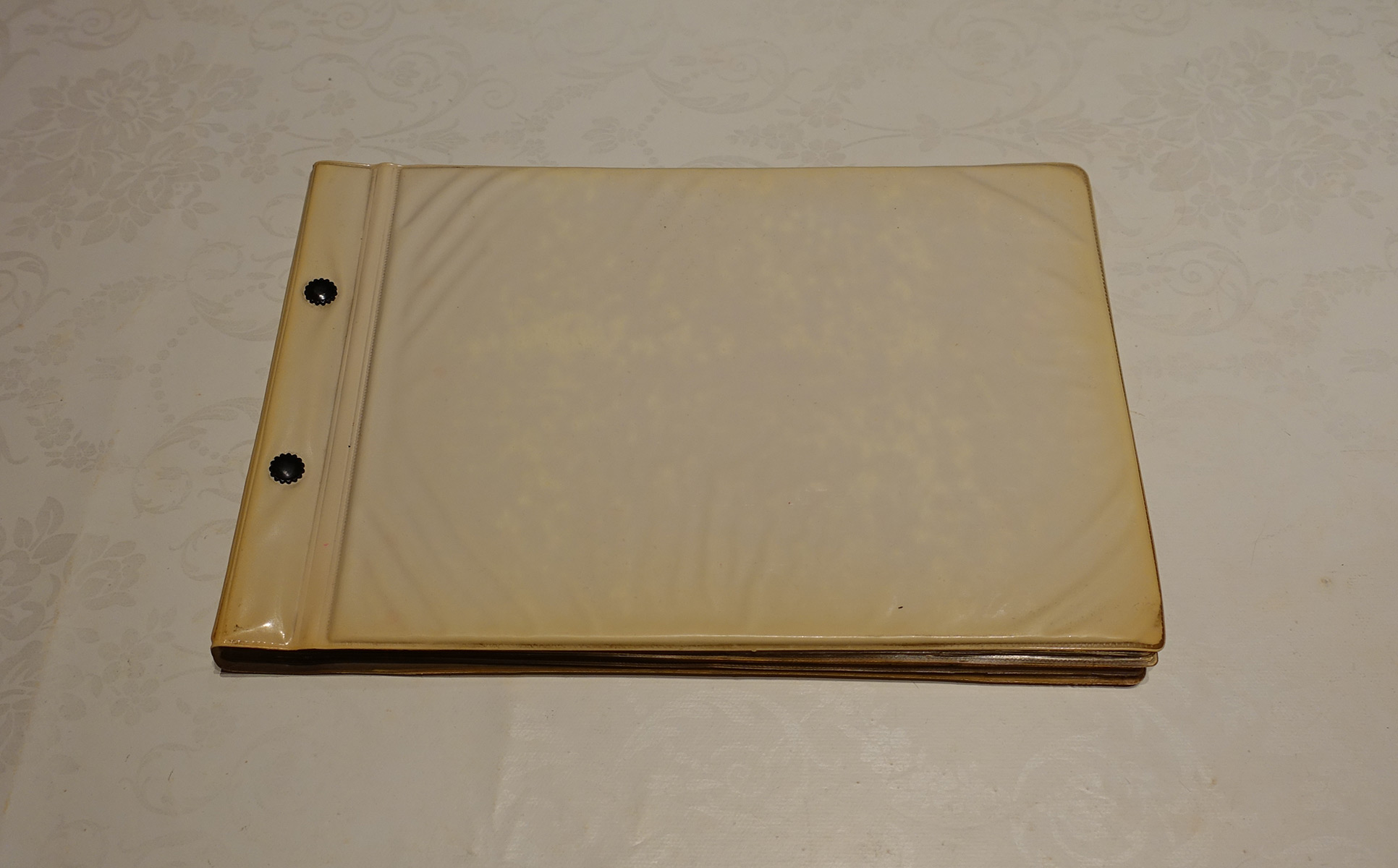 A fehér album összeállítása
This was the very first album created by the artist Lóránt Méhes from the photos accumulating in his box, incorporating the best photos from his collection. In this sense it differs from the rest of the compilations, which are all arranged in chronological order (these photos are featured exclusively here and are missing from those other chronologies).
Its exterior is also different: while the later albums are in portrait format and the photographs are fixed on black cardboard, this one is in landscape format, and the photos are compartmentalized.
 Pandele, Andrei. Queues during communism, 1985-1989. Photographs
In the last decades of Romanian communism, queues for various foodstuffs or common consumer goods were an everyday sight. Images of queues are common to all the former communist countries in Central and Eastern Europe. However Andrei Pandele’s photographs are different because they illustrate a period of decay and degradation of human life that was unparalleled in the Soviet bloc. They show the absurdity of the arbitrary measures taken by the Ceaușescu regime, which reintroduced food rationing on the pretext of so-called “rational nutrition.” The severe shortage of food products was the direct result of the decision to be able to pay off Romania’s foreign debt and so become less dependent on the West, thus implicitly being under less pressure to release dissidents who had been arrested for the crime of criticising the regime’s policies. Andrei Pandele’s photographs are impressive because they show not only a dark and dirty Bucharest with interminable queues, but also people completely without hope. “It took me years to notice what I wasn’t interesting in noticing. People look, and as a rule, they only see what interests them. It’s absolutely natural. It was a question of practice, of education of the eye, to which, I must acknowledge, my architectural training had also contributed. Why do I say this? Because I was not, at first, in real time, conscious of exactly what I was photographing. Some places, their hidden, grave symbolism, I myself discovered long after I had taken the pictures. Often we see what we are able to see…,” says Andrei Pandele, with regard to what he calls a “rabid abnormality.” In this connection, he mentions that: “in my photographs of everyday life during communism, implicit, but visible when you look carefully at the photographs, is the abnormality that is/was represented by the small details. Buckets of cheese on the pavement. Or shopping backs lined up on the pavement, empty bags. Or bottles of milk frozen in the street. And many other things. It was, as I say, a rabid abnormality.”
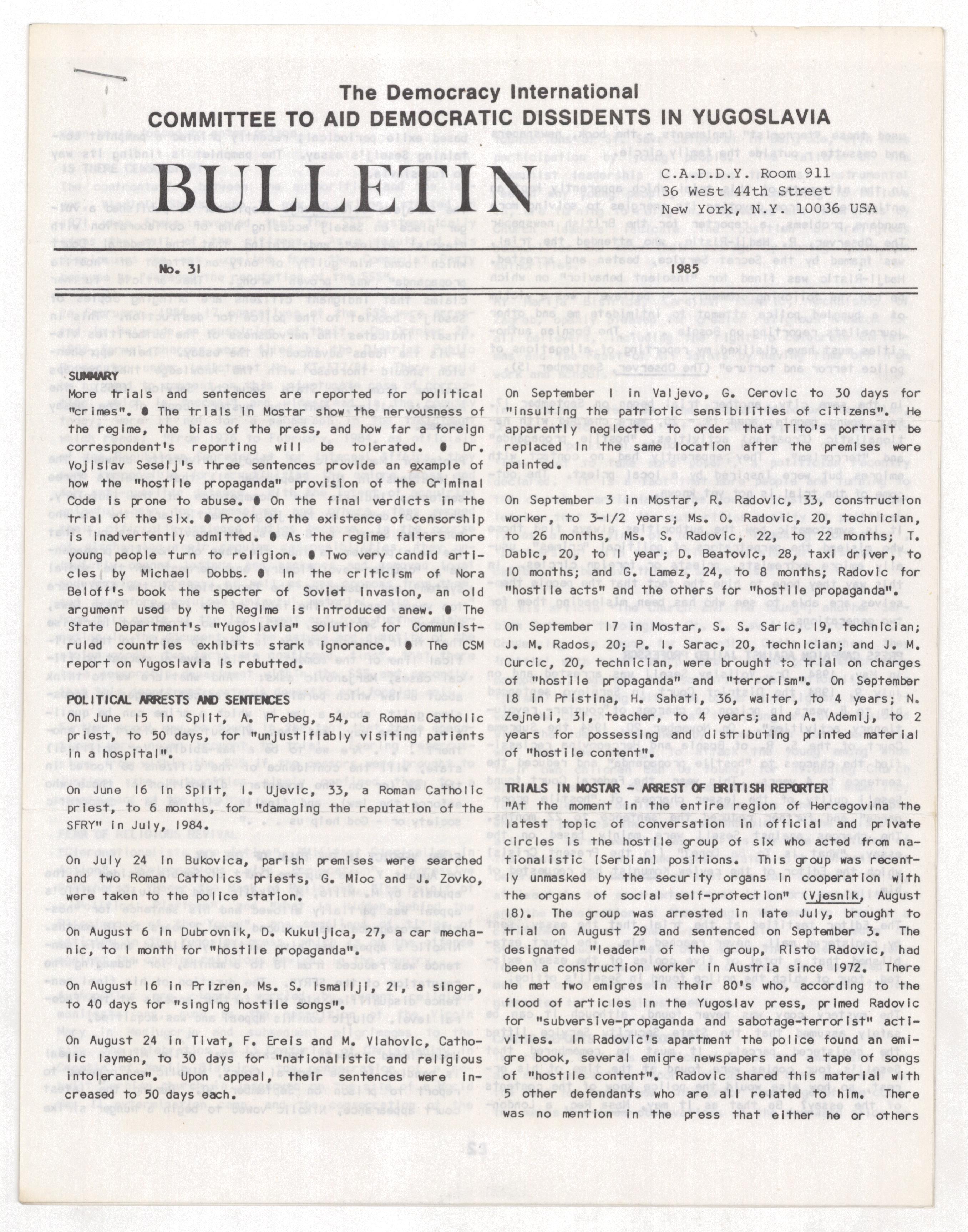


 Letter from Virgil Ierunca to Sanda Budiș, in Romanian, 25 February 1985
This letter is an important document for the history of the post-war Romanian exile community because it is proof of the activity of fighting communist propaganda outside the country, as well as of the integration of Romanian culture into Western culture. Such activity was also carried out by Sanda Budiș, an exile community personality, who emigrated to Switzerland in 1973. One of her actions, alongside another representative of the Romanian exile community in Switzerland, the lawyer Dumitru Stambuliu, consisted in supplying the Swiss Library for Eastern Europe in Bern with publications of the Romanian exile community. The starting point of Sanda Budiș’s project was a book donation from Romania, which the Romanian ambassador to Switzerland made to the Cantonal and University Library of Lausanne in 1984. This donation took place during a festivity advertised in the local press. In response, Sanda Budiș took the initiative to donate publications of the Romanian exile community from her personal library to this library, but her donation was denied "for political reasons." Consequently, she addressed the leadership of another institution – the Swiss Library for Eastern Europe in Bern – which served at the time as a documentary fonds for the Swiss Eastern Institute (Institut suisse de recherche sur les pays de l'Est–ISE/Schweizerische Ostinstitut–SOI), an institute that carried out research on communist countries. At the Institute, both the management and the members were Swiss personalities with authority in their field of expertise. The management of this library accepted her donation “with great satisfaction, especially as it is literally flooded by propaganda publications sent free and regularly by the various propaganda officers of the Ceaușescu regime.” In order to counteract the propaganda of the Romanian communist authorities, Sanda Budiș continued her efforts by sending letters to the management of important and representative publications of the Romanian exile community. Among the recipients of such letters was Virgil Ierunca, who accepted her invitation and sent to the library not only newspapers and magazines of the exile community, but also books published by Romanians abroad. Ierunca also responded to Sanda Budiș in a letter in which he congratulated and thanked her for the action she had initiated. The original handwritten letter is to be found today in the Sanda Budiş Collection at IICCMER.


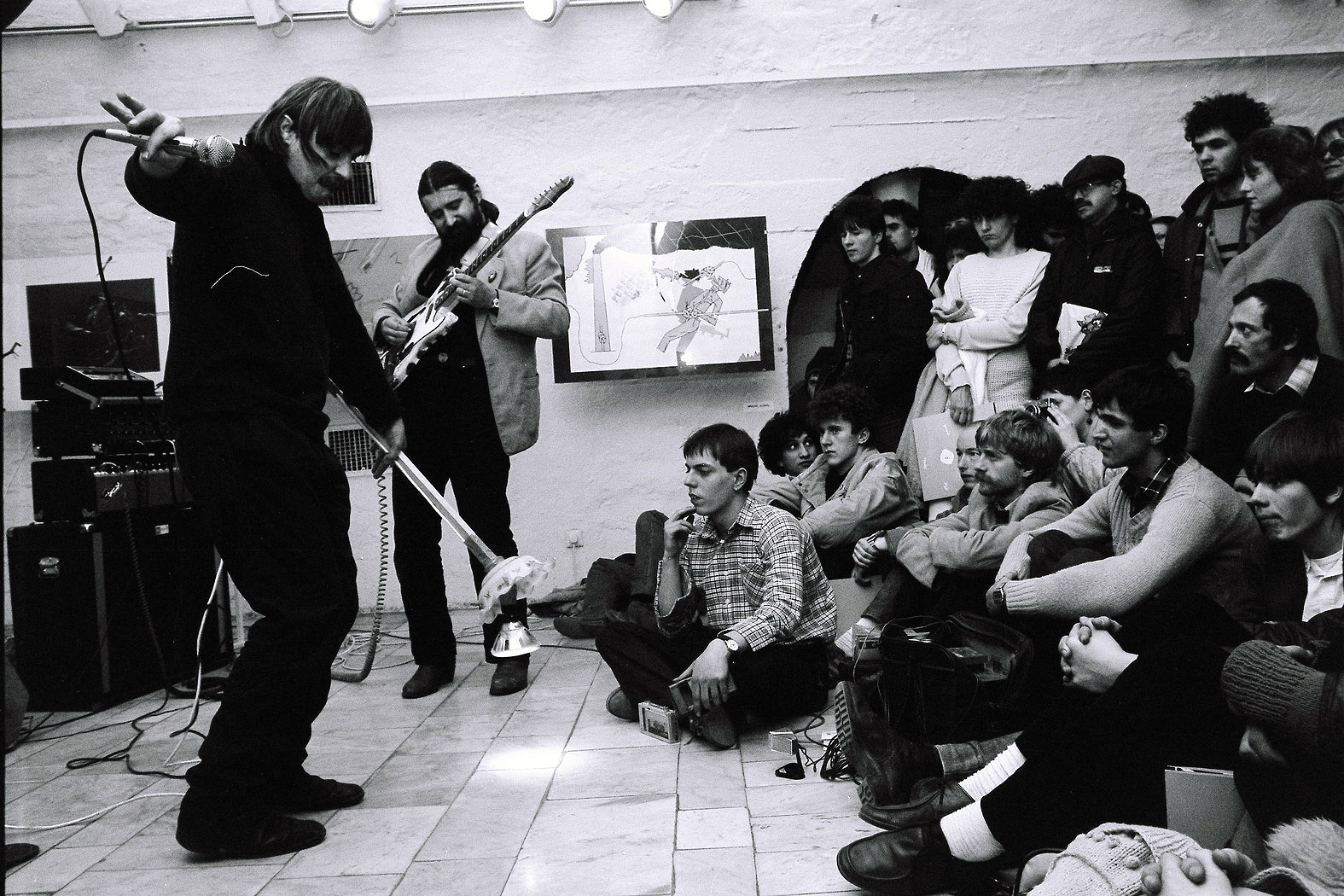 Kálmándy Ferenc: A Neoszarvasbika együttes koncertje, 1985. (fotó)
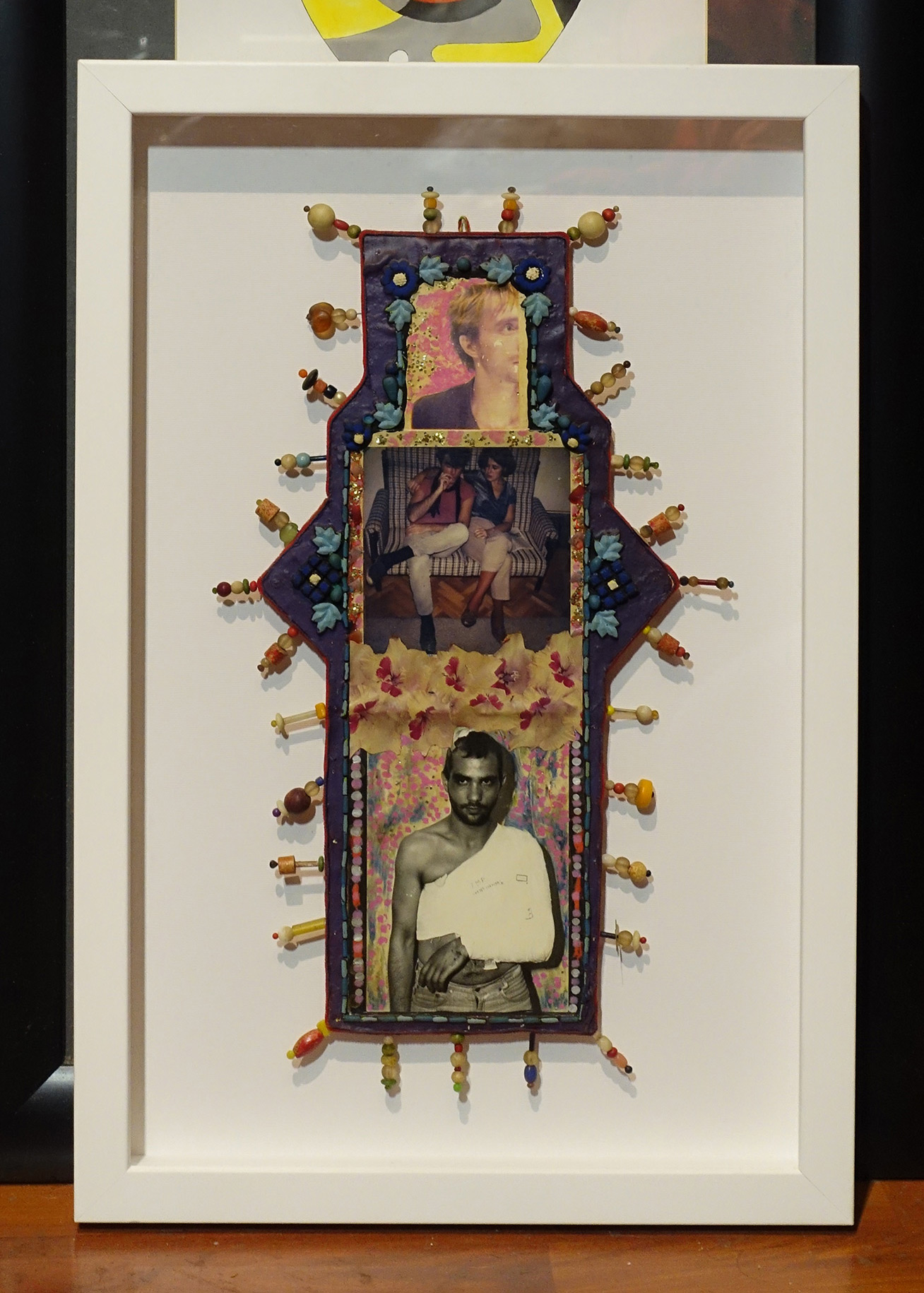 Társaság, fotófestmény, 1985
20 x 34 cm (29 x 43 cm framed), photos, cardboard, velour, acrylic, pearls
Three photos underlie the composition, arranged onto one surface, decorated with paint and pearls. The main members of the circle of friends are shown in the photos: Prince January (János Baksa Soós) in the upper section, Zuzu (Lóránt Méhes) and his girlfriend, Kriszta Kecskés, in the middle, and János Vető below.
The composition evokes an ideal situation where companionship is complete. Prince January lived in Berlin, visited Budapest only once a year, mostly in autumn, stayed usually for a month. He sent the featured photo by mail, an intentionally decomposed snapshot made with an instant camera; only half of his face is seen in the frame.
Zuzu and Kriszta are in synch with each other in terms of clothes and attitude. The selection criterion for the photo was that it emanates the atmosphere of the era. Zuzu smokes on his joint, Kriszta embraces him, as the love seat embraces them too.
The photo of János Vető is dramatic, not only because it is black and white: the image was taken after a serious car accident (a couple of years ago), his shoulder, chest, and left arm are in cast. Appropriate to the situation, his face is serious, and he is the only one looking into the camera.
According to the author’s comment, it is a spontaneously created, handcrafted composition. First the photos were attached to the cardboard, then the paint, pearls, glass, and velour were added. “I felt like a folk artist during production,” commented Zuzu, “like a shepherd, decorated as much as possible.”
The finished picture was then hanged in the hall of his apartment. January was moved a bit by seeing it. Later he also made a composition in response, with an image of Zuzu also sent to him in the mail. He too cultivated a craftsman’s attitude. They were following the work of each other. He even depicted Zuzu as a duke for his drawing series, “Primeval Light – Pathway.”
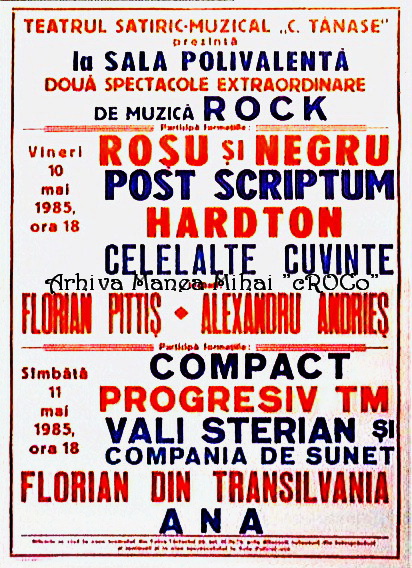
 ANSCHLAG



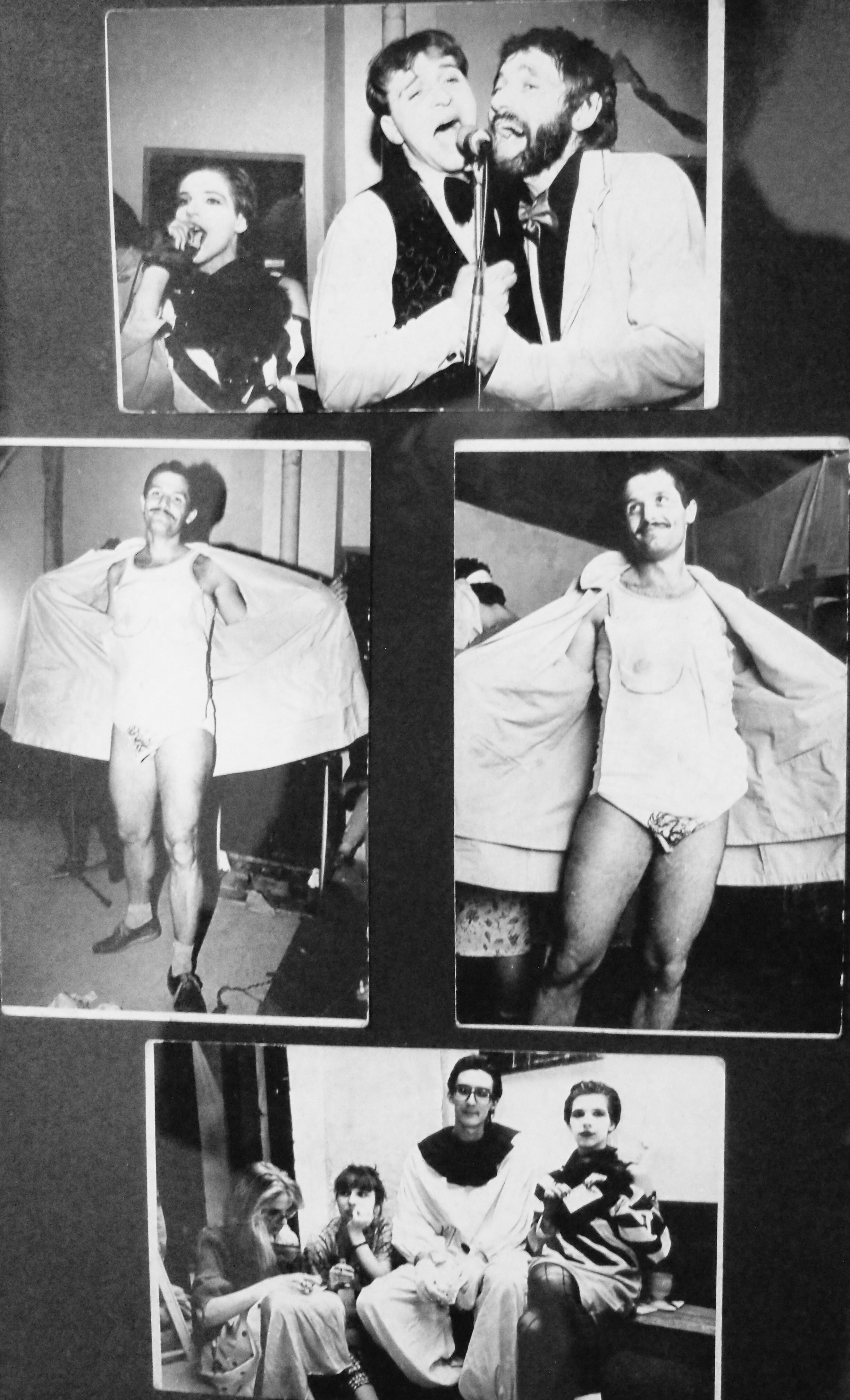 Home concerts and performances, 1985. Photo montage
 Private Butcher Shop
 Ivan Aralica Collection of Press Clippings
The Ivan Aralica Collection of Press Clippings contains articles, documents and letters presenting the heated polemics in the Yugoslav press in 1985 and 1986. Members of the Association of Veterans of the People's Liberation War (SUBNOR) tried to proclaim award-winning author Ivan Aralica as politically unfit for literary work in a socialist society due to his involvement in the "counter-revolutionary" Croatian Spring (1967-71). The collection contains outstanding materials to studying the microhistory of censorship through pressure on public opinion.
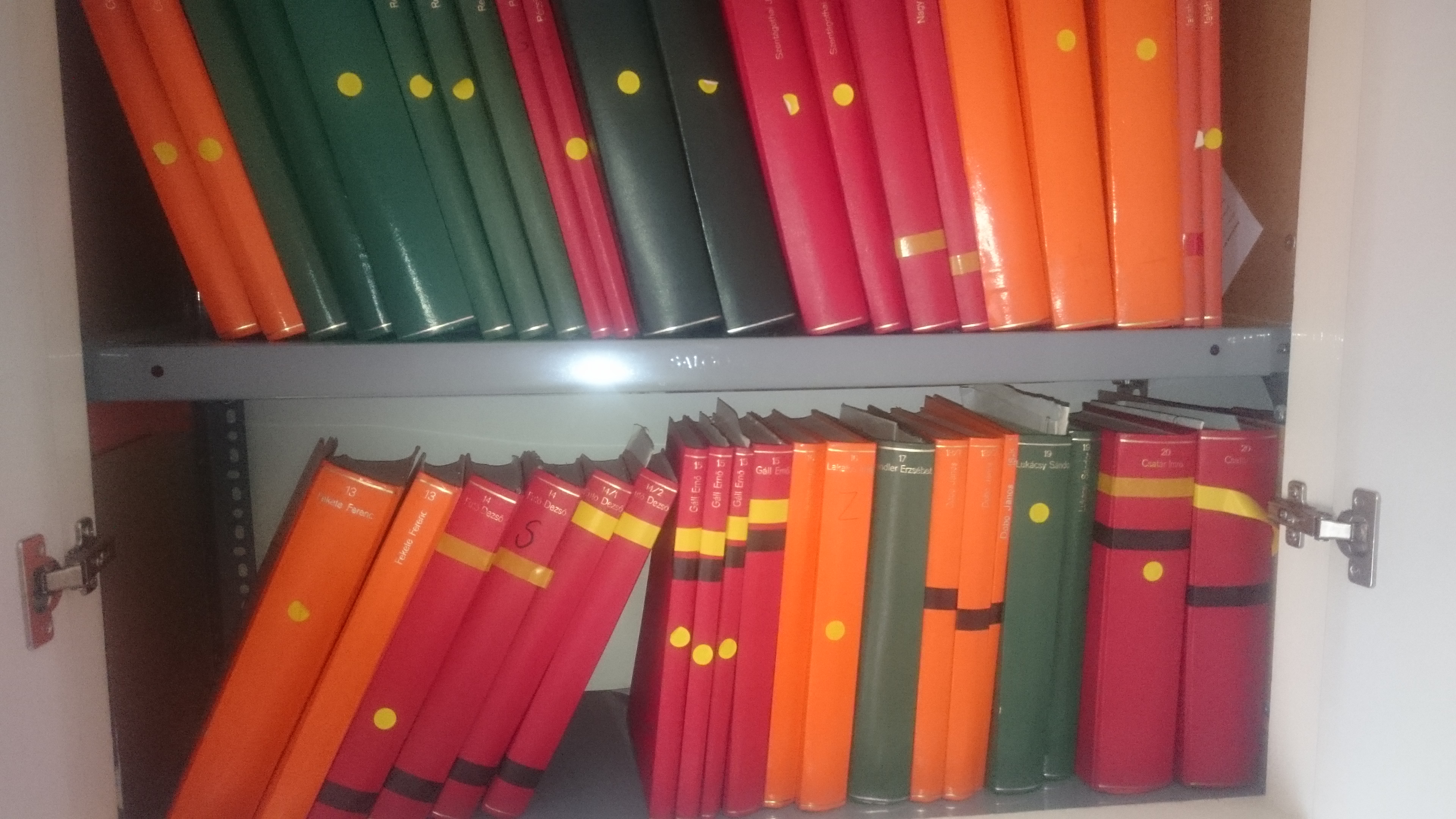 Oral History Archives (OHA) in 1956 Institute
A small group of devoted researchers began to do interviews in 1981 with people who had been active in the 1956 Hungarian Revolution. The aim of people who did the interviews was to reveal, by giving people chances to share personal memories, the real story of this decisive set of events, which were taboo under the Kádár regime, which had violently suppressed the revolution and which was eager to make up for its lack legitimacy in the eyes of the population by spreading false propaganda. These early interviews later served as the core collection of the Oral History Archives, which was founded in Budapest in 1985.
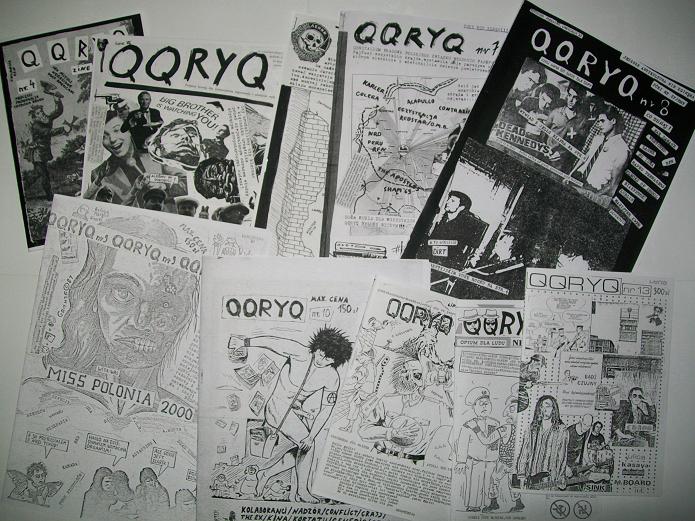 Kolekcja Piotra "Pietii" Wierzbickiego
The private collection created and owned by Piotr ‘Pietia’ Wierzbicki contains hardcore punk fanzines, articles, and papers from the 1980s, including the original matrices of ‘QQRYQ’ fanzine edited and published by Wierzbicki from 1985. ‘QQRYQ’ was the leading Polish magazine about the underground punk scene and Wierzbicki became an influential author and promoter on that scene.
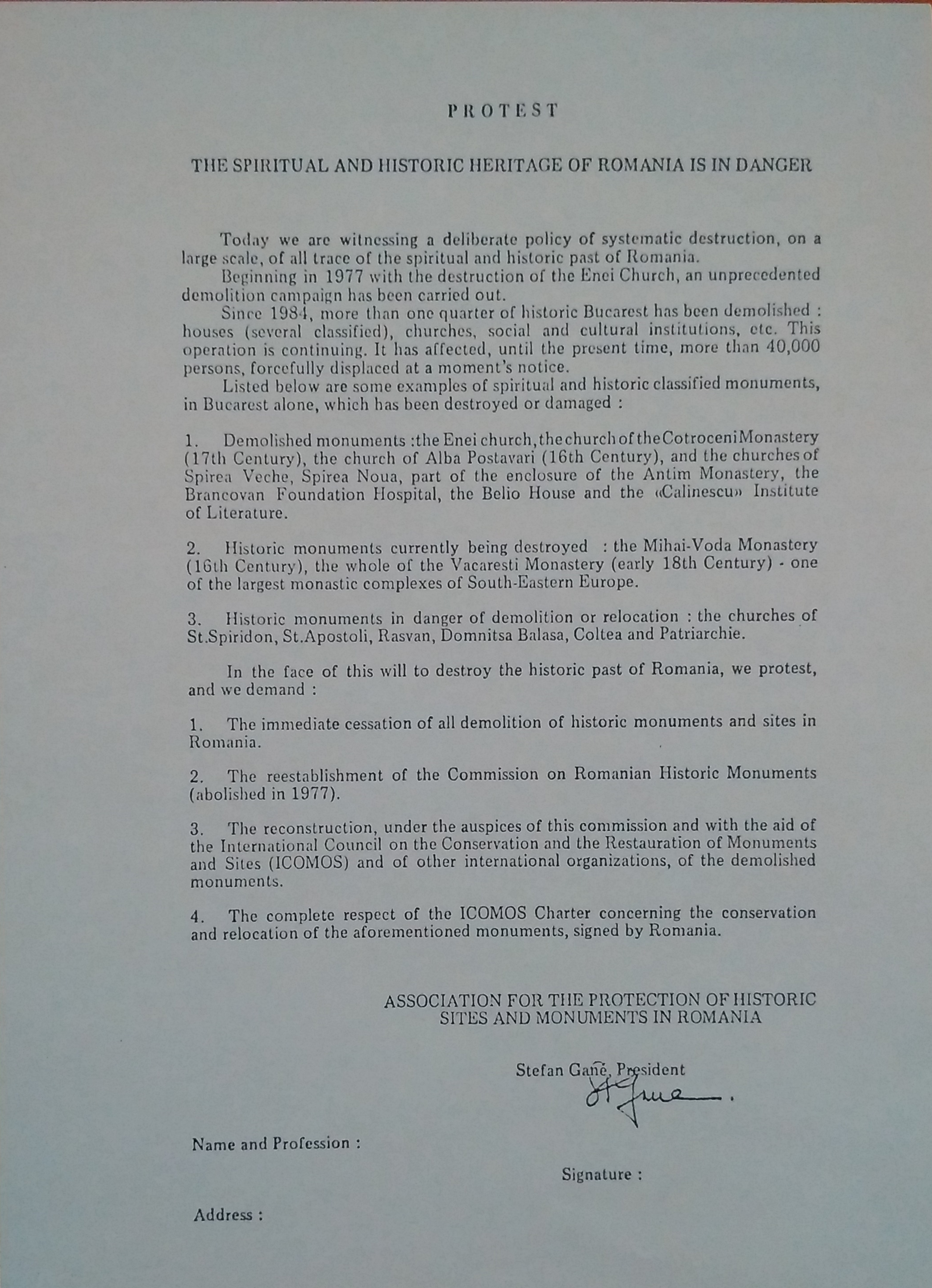 Mesaj de protest al Asociației Internaționale pentru Protejarea Monumentelor și Siturilor Istorice din România, în franceză și engleză, Paris, 1985
This document reflects the way in which the Romanian exile community organised itself and acted to promote media coverage in the West of the urban systematisation project of Ceaușescu's regime, which tacitly involved the demolition, mutilation, or destruction of the national heritage. The protest message was shared when the International Association for the Protection of Monuments and Historic Sites in Romania was founded in 1985, in Paris. The purpose of the association was to draw the attention of political decision-makers and international public opinion to the communist regime's plan for the demolition of the architectural and urban heritage of Romania. The actions undertaken within the Association focused particularly on the promotion of media coverage of the demolition of the city centre of Bucharest, which the communist authorities planned to reorganise according to their architectural vision. On the occasion of its foundation, the association organised a protest on the streets of Paris, during which it distributed a protest message to participants and passers-by with texts about communist Romania accompanied by photographs of historic monuments destroyed by the communists or scheduled to be demolished or moved. A copy of this protest message was sent by post to several Romanian exiles in order to convince them to join the Association and get involved in unmasking the communist regime in Romania and, in particular, the urban systematisation project of the Ceaușescu regime. This document was sent by the president of the Association, the architect Ștefan Gane, to Sanda Stolojan, a personality of the Romanian exile, who kept it in her private archive. The document, which can be consulted in the IICCMER collection, was written in English and French, in A4 format. The material, titled "Protest: Romania's historical and spiritual heritage is in danger," briefly outlines the consequences of the Bucharest systematisation project undertaken by the Communist authorities since 1977 and some examples of monuments from the historical and spiritual heritage of the Romanians that had been destroyed, demolished, or mutilated by the Ceaușescu regime. Against this background, the association protested, asking for: a stop to the demolition of historic monuments and sites in the country; the re-establishment of the Romanian Historic Monuments Commission, abolished in 1977; and the rebuilding, under the aegis of this Commission and with the help of the International Council for the Conservation and Restoration of Monuments and Sites and other international organisations, of the demolished historic monuments and sites.
 KwieKulik show "Festiwal Inteligencji i Kraty", photo, 1985
The neo-avant-garde duo of Zofia Kulik and Przemysław Kwiek was frequently performing in Dziekanka in the 1970s and 1980s. In the space of Dziekanka, KwieKulik made performances, showed their art on exhibitions and presentations, took part in discussions and symposiums. As a good example of their activity in Dziekanka could serve the performance Festiwal Inteligencji i Kraty (Festival of Intelligence and Bars) from March 4, 1985. The attached photography showed the artists making the performance.
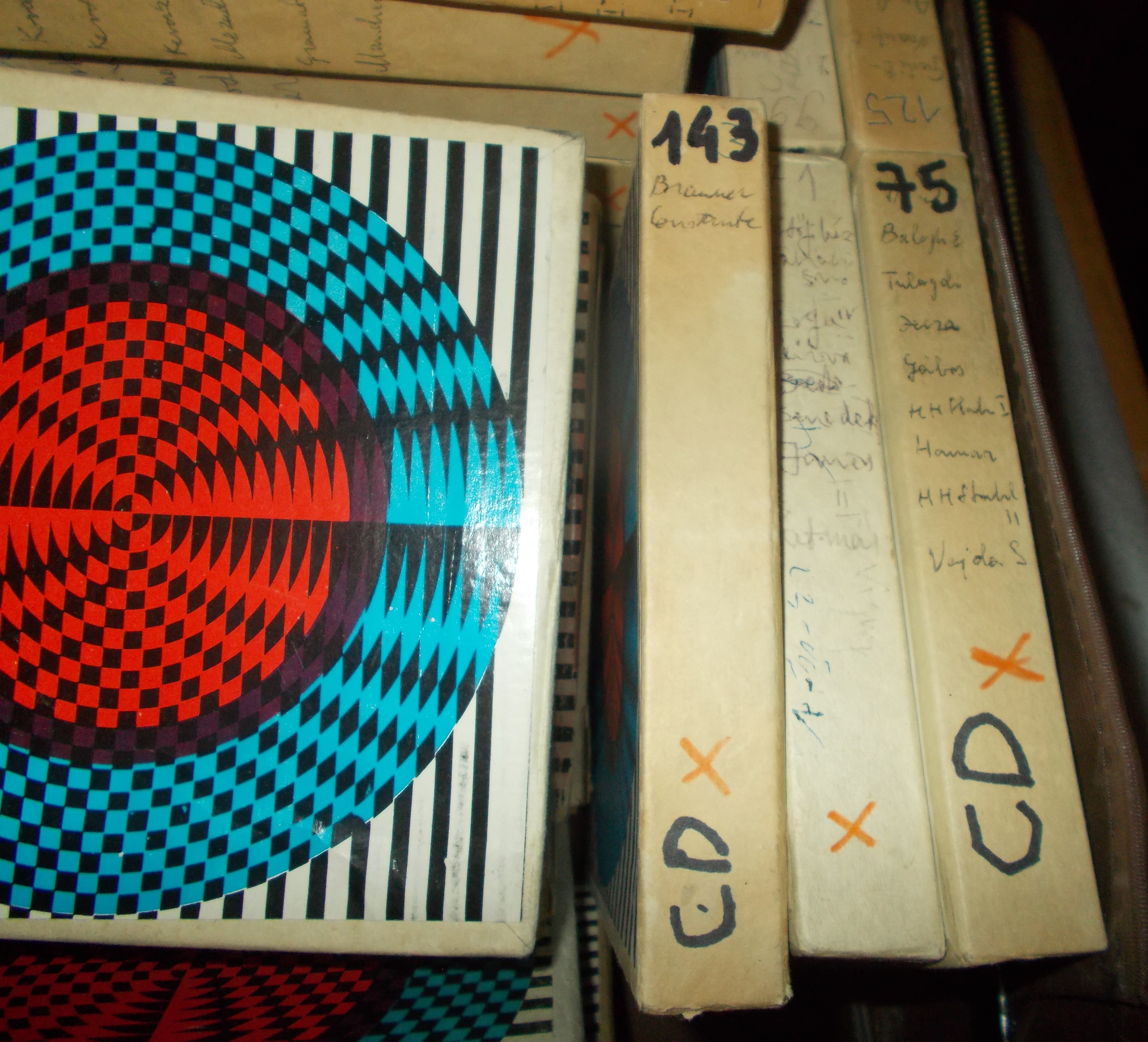 Lena Constante and Harry Brauner, interview by Zoltán Rostás, in Romanian, 1985. Tape recording
The tape on which are imprinted the voices of two personalities of Romanian culture, Lena Constante and Harry Brauner, is today in the Zoltán Rostás private collection and contains an extensive interview taken with the couple in 1985. Harry Brauner (1908–1998) was a Romanian folklorist and ethnomusicologist of Jewish origin, who came from a family that included other notable intellectuals: his brothers were the surrealist painter Victor Brauner and the photographer Theodore (Teddy) Brauner. Lena Constante (1909–2005) was an artist and folklorist of Aromanian origin, and the author of a number of well-known postcommunist volumes, which were well received by readers of memorialistic literature. The couple were involved in a famous political trial, which had as its central figure Lucreţiu Pătrăşcanu, an intellectual of Marxist orientation and an important political leader after 1945, arrested in 1948 and executed in 1954. This political trial was to have been a show trial, like those of László Rajk in Hungary and Rudolf Slánský in Czeschoslovakia, but in the end it was orchestrated behind closed doors, on the basis of false testimonies squeezed out of some of those included among the accused, as in similar cases in the Soviet bloc. In 1954, Harry Brauner was sentenced by the communist authorities to 15 years in prison and Lena Constante to 12. Both were released in 1962, after 12 years, but Brauner had to remain in “obligatory domicile” on the Bărăgan plain until 1964, when all political prisoners were released. The two only got married after their time in prison, while Brauner was still in forced domicile. In 1968, both were politically rehabilitated by Nicolae Ceauşescu, who had initiated a belated de-Stalinization and was reviewing some of the political trials orchestrated by his predecessor, Gheorghe Gheorghiu-Dej, in order to gain political capital. After 1989, the Pătrăşcanu trial was one of the most visited subjects out of the whole period of Romanian communism, owing to the political and intellectual eminence of those included among the accused. The interview carried out in 1985 by Zoltán Rostás also includes the couple’s testimonies about political imprisonment and forced domicile, subjects that were and still are of maximum interest for the majority of historians of postcommunist Romania. Here is an extract from Harry Brauner’s reflection on the significance of his experience of incarceration, remarkable for the way in which he synthesizes the essence of the absence of the rule of law under communism in a period in which there was effectively no access to professional analyses of undemocratic regimes: “ZR: Were you really so dangerous that after you had come out of prison they also gave you obligatory domicile? HB: Yes, it seems that I was very dangerous. Much more dangerous than I imagined. But at the same time, I was a good example for all the others, don’t you think? ZR: In what sense? HB: Ah, you haven’t understood what I mean. I was a good example for intellectuals, for artists, for all those who could see an example of what could happen to a man who had done nothing.” The aim of the 1985 interview was broader, however. The recording includes discussions referring to the beginnings of the couple’s relationship, to intellectual life in the interwar and postwar periods, and above all to many details of their contribution to the researches of the Gustian sociological school. “It was, I remember, a single meeting, but quite a long one. Lena Constante spoke significantly more than Harry Brauner, as he preferred to be very concise in the answers he gave me. By the way, he was a character in himself, with a voice and a ceremony of speaking that were quite distinctive. Indeed he is the character in a well-known novel by Marin Preda,” says Zoltán Rostás, recalling the meeting of which the dialogues are preserved on the magnetic tape in his private collection.
 Stănescu, Mihai. Vizită de lucru (Working visit), 1983. Caricature
Clearly dated 1983, the cartoon “Working Visit” was probably among those withdrawn from the exhibition at the Eforie Gallery that year. It was subsequently omitted from the volumes later prepared by Mihai Stănescu before 1989, but it was included in the volume Best of Stănescu, which comprises works from the period 1979–1989 and was published in 2009 on the occasion of the twentieth anniversary of the fall of communism. The cartoon “Working Visit” shows a crowd of people drawn like parquet pieces on which footprints can be seen. The drawing mocks in a tragic-comic key the so-called “working visits” made by the secretary general of the Party, Nicolae Ceauşescu, together with his suite of communist officials, to various cities, to factories, building sites, and cultivated fields. These working visits, unknown in the time of Gheorghe Gheorghiu-Dej but introduced and intensely promoted by Ceauşescu, followed broadly the same pattern: the Party delegation, led by Ceauşescu himself and in most cases also including his wife Elena, travelled to various “objectives.” There they were greeted by the local authorities and frenetically applauded by crowds of people specially mobilised to give the distinguished guests a long ovation. During these visits, Ceauşescu formulated so-called “precious indications” regarding what ought to be done in the factory, building site, or agricultural cooperative that he was visiting. Once launched, these “indications” became the letter of the law, no matter how absurd they were, and those on whom they had been bestowed dared not contradict them, even when specialists understood that they could produce disastrous effects. In essence, the “indications” symbolised the arbitrary character of decisions in a dictatorial regime. At the same time, for the presidential couple as for the rest of the officials of the communist regime, these “working visits” constituted what we would today call an image-building exercise. At the time, they were an obligatory element in the complex arsenal of the personality cult. For the crowds of people brought to attend these working visits, they were an exercise in accepted humiliation. This is what Mihai Stănescu manages to show through the cartoon “Working Visit.” This cartoon is one of the most well-known works in his portfolio, and indeed in the history of Romanian cartoons under communism.
